









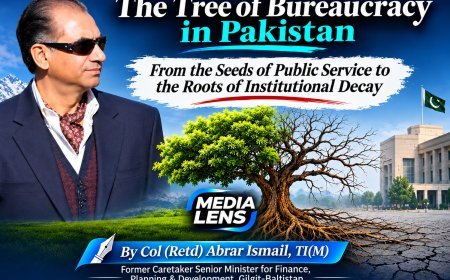











The Tree of Bureaucracy in Pakistan

By Col (Retd) Abrar Ismail, TI(M)
A nation's bureaucracy is much like a tree. Its roots provide stability, its trunk gives it strength, its branches extend its reach, and its fruits represent the benefits it delivers to society.
When nurtured with integrity, competence, accountability and a genuine commitment to public service, this tree can grow into a powerful institution capable of supporting generations.
But when its roots become weak, its branches grow in the wrong direction and termites begin eating away at its foundations, even the tallest tree eventually becomes hollow.
Pakistan's bureaucracy presents an interesting reflection of this phenomenon.
Every year, young and talented individuals enter the civil service with dreams of serving their country. They bring academic excellence, enthusiasm, ambition and a sincere belief that they can contribute towards building a better Pakistan.
Yet, as they progress through the administrative hierarchy, many encounter an institutional culture that can gradually challenge their original ideals.
The question is not simply how far an officer rises within the system, but what happens to his or her values along the way.
The Seeds.
The Promise of a New Beginning.
Every great tree begins with a seed.
The young officers entering Pakistan's civil service represent these seeds of hope. They are educated, energetic, ambitious and often genuinely committed to bringing positive change.
They dream of improving education, strengthening healthcare, developing infrastructure, facilitating investment and making government institutions more responsive to citizens.
They believe in merit, justice, transparency and the power of honest administration.
At this stage, their motivation is often uncomplicated: they want to serve.
However, their first encounter with the administrative machinery can be an ey opener. They discover that good intentions alone cannot overcome entrenched procedures, bureaucratic resistance, political interference and institutional inertia.
Some remain firmly committed to their principles. Others begin adapting to the prevailing culture, sometimes at the expense of the very ideals that brought them into public service.
The real test begins here, whether the seed of integrity will grow into a strong tree or become another product of an unhealthy institutional environment.
The Trunk.
The Structure of Power and Advancement
As officers gain experience, promotions and greater responsibilities, they become part of the trunk of the administrative structure.
This is where professional competence should translate into institutional strength.
Experience should improve decision making, promotions should bring greater responsibility, and authority should enable officers to deliver better public services.
Unfortunately, the system sometimes introduces a different set of priorities.
Career advancement, influential postings, proximity to political leadership, protocol and personal networking can gradually become more important than professional performance.
Some officers become increasingly cautious, calculating and protective of their positions. Taking an independent decision becomes a risk, while pleasing those in authority becomes a convenient survival strategy.
Ambition itself is not the problem. Every professional institution needs ambitious people.
The problem arises when ambition replaces integrity, personal advancement supersedes public interest, and loyalty to individuals becomes more important than loyalty to the state.
The trunk of a tree must provide strength to its branches. Similarly, the administrative hierarchy must strengthen public institutions rather than become an instrument of personal influence.
The Branches. Senior Leadership and the Responsibility of Authority.
The upper branches of the tree represent senior bureaucratic leadership.
These are the individuals who occupy influential positions, shape policies, allocate resources and influence decisions affecting millions of citizens.
At this level, experience and authority can become powerful instruments of national development.
A visionary and competent senior officer can remove administrative bottlenecks, encourage investment, strengthen governance, improve service delivery and introduce reforms that transform entire sectors.
But authority without accountability can produce the opposite results.
Experience can turn into resistance to change. Institutional influence can become personal dominance. Administrative discretion can be used to protect established interests rather than promote public welfare.
The real tragedy occurs when institutions begin revolving around individuals rather than individuals serving institutions.
A strong administrative system should never depend on the personality of one secretary, chief secretary or departmental head.
Its strength should lie in transparent procedures, institutional continuity, professional independence and accountability.
The branches of a healthy tree should extend towards sunlight, not become entangled in one another while denying growth to the rest of the structure.
The Fruits.
What Does the Bureaucracy Actually Deliver ?
The ultimate purpose of a tree is not merely to grow tall or spread its branches. It must also produce fruit.
Similarly, the success of bureaucracy should not be measured by the number of officers, the grandeur of government buildings, the length of official files or the protocol associated with senior positions.
Its real achievement must be measured by what citizens receive.
Can a poor family access healthcare without unnecessary hurdles?
Can a deserving student receive educational opportunities ?
Can an entrepreneur establish a business without running from one government office to another ?
Can an investor obtain a legitimate approval without unnecessary delays and informal demand ?
Can a farmer, a worker or an ordinary citizen obtain justice without influence or connections ?
These are the real fruits of governance.
A bureaucracy that produces impressive reports but fails to improve people's lives is like a tree that grows leaves but never bears fruit.
Pakistan needs an administration that measures success through outcomes, not appearances.
The Termites. Corruption, Nepotism and Abuse of Authority
Perhaps the greatest danger to any tree comes from termites.
They work silently, often remaining invisible until considerable damage has already been done.
In Pakistan's administrative structure, corruption, nepotism, manipulation, exploitation and abuse of authority perform a similar function.
They weaken institutions from within.
Public office may become a source of personal enrichment. Administrative discretion may be misused to intimidate or favour. Rules may be selectively applied, while merit and transparency become casualties of personal connections and vested interests.
The damage extends far beyond financial corruption.
It discourages honest officers, destroys public confidence, drives away investors, undermines economic growth and creates a society where access and influence appear more valuable than merit and justice.
A citizen waiting endlessly for a legitimate decision, a patient deprived of timely medical attention, a young graduate unable to find opportunities or an investor frustrated by unnecessary administrative obstacles all experience the consequences of this institutional decay.
The most dangerous termites are not necessarily those who openly violate the law. They are also those who quietly normalise wrongdoing, protect the corrupt, discourage honest colleagues and turn institutional silence into a survival mechanism.
Eventually, even a seemingly impressive administrative structure can become hollow from within.
The Soil Must Change.
Reforming the System.
It would be unfair to suggest that Pakistan's entire bureaucracy is corrupt or inefficient. The country has many honest, capable and dedicated civil servants who perform their responsibilities under difficult circumstances.
Many work with inadequate resources, political pressures, frequent transfers and institutional constraints.
Therefore, the solution cannot simply be to blame individuals or reshuffle administrative positions.
The soil in which the tree grows must also be improved.
Pakistan needs fundamental administrative reforms:-
1.Merit based appointments and promotions.
Professional competence and measurable performance must take precedence over personal connections and influence.
2. Institutional continuity.
Arbitrary transfers and politically motivated postings must end. Officers should have reasonable tenure to complete their assignments and be held accountable for results.
3. Digital governance.
Government procedures should be digitised to reduce unnecessary human discretion, improve transparency and minimise opportunities for corruption.
4. Impartial accountability.
Accountability must apply equally to everyone, regardless of designation, political connections or administrative influence.
5. Protection of honest decision makers.
Officers taking lawful and professionally sound decisions in the public interest should be protected rather than intimidated through retrospective scrutiny.
6.Citizen centred administration.
The performance of government departments should be evaluated through the quality, accessibility and efficiency of services delivered to the public.
Most importantly, the culture of public service must be restored.
Authority is not ownership. A government position is not a personal privilege. It is a responsibility entrusted by the state on behalf of its citizens.
The Final Question:-
What Kind of Tree Are We Growing ?
Pakistan does not need a bureaucracy that merely grows taller, develops more branches or produces more powerful officeholders.
It needs a bureaucracy with strong roots of integrity, a healthy institutional structure, responsible leadership and fruits that ordinary citizens can actually enjoy.
The young officer who enters public service with dreams must not lose those dreams while climbing the administrative ladder.
The senior officer who acquires authority must understand that his greatest achievement is not the influence he commands, but the institutions he strengthens and the lives he improves.
And those who occupy positions of power must remember that no tree can survive indefinitely when its roots are consumed by termites.
Perhaps the greatest challenge facing Pakistan's bureaucracy is not to produce more powerful officers, but to preserve the character, conscience and commitment of those who hold public office.*
A nation's progress does not depend on how tall its administrative tree appears, but on how deep its roots of integrity go, how strong its institutional foundations remain and how much fruit it delivers to its people.
Ultimately, the true measure of bureaucracy is not the power it accumulates, but the public good it produces.
---
The author is Former Caretaker Senior Minister for Finance, Planning & Development, Gilgit-Baltistan.
What's Your Reaction?
 Like
0
 Dislike
0
 Love
0
 Funny
0
 Angry
0
 Sad
0
 Wow
0